
Learning happens when we work at doing something that challenges us. Something that doesn’t necessarily come easily.
I recently read a research study on AI and essay writing. I was interested in this having taught essay writing in the past but also for what it said about learning processes more broadly. Including processes that relate to riding bikes.

Students using AI to write their essays got better marks (not a huge surprise). The more interesting result of the study is that these students missed the benefits of learning how to write an essay.
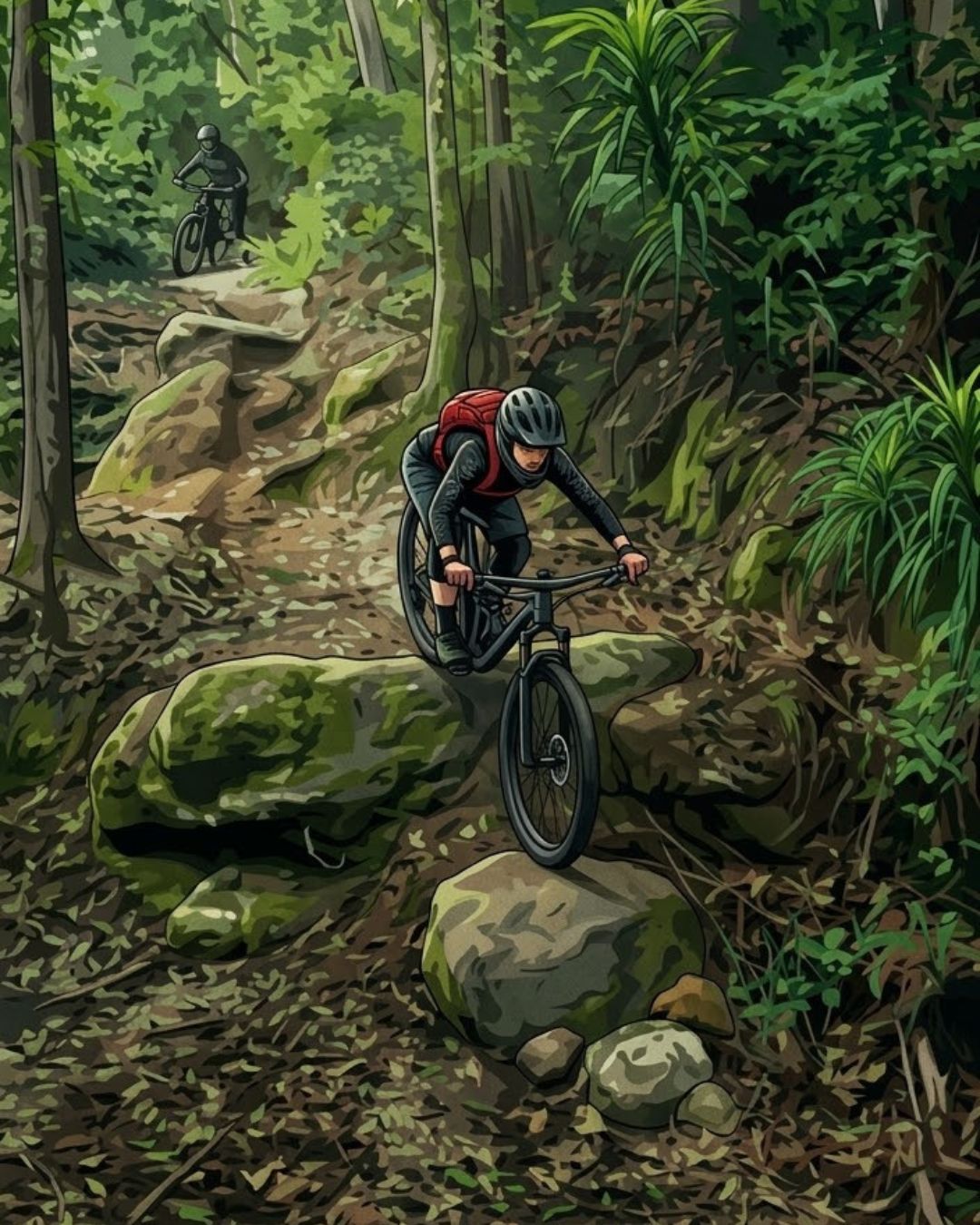
I’m willing to bet that if the researchers tested how well students benefited from learning to prompt and direct a GPT better they would have shown that something was indeed learned, even if it wasn’t the learning outcomes they hoped. (Or as good as these images. Here’s another one.)

Riding offers countless benefits from the process of learning, and is arguably a lot more fun than essay writing.
Some bike skills come easily, at least for some of us. But there are some trail features that we have to work at for a while before we can ride them more smoothly, confidently and with control.
As we work at mastering a new section of trail, we don’t just learn how to ride that one feature. We learn emotion regulation, impulse control, and how to break complex problems into manageable parts. We learn how to practice over there, so we can succeed over here.
The best part is that in working on this, we learn skills that carry over to many other situations. One reason for this is that learning makes some strategies more explicit (like how to cue a particular technique when it’s not ‘just happening’), while others start to happen more automatically.

Pause for a second now and think of a new skill or section of trail you’ve mastered recently (use a non-bike example if another skill or passion brought you to this article). Now think about how much some kind of mental strategy helped with that process.
Now pause for another second and think about how a similar strategy has helped you in another situation that seems like it has nothing to do with bikes. Emotion regulation maybe. Trusting your body to respond to a cue that helps you move where and how you want to. Knowing when to try harder. Knowing when to back off for a bit, and come back to something later.

Next time you find a new aspect of riding that challenges you, I hope that it’s not just the outcome that gives a winning feeling, but it’s the process of learning – and overcoming – that makes you excited for more.
I’ve lost count of all the ways time on the bike has helped me through tricky situations in my off-bike life. I sure am grateful for it. And, as AI transforms learning in classrooms and workplaces, I’m grateful that every bike ride, and every riding goal, is a chance to keep developing skills by putting our bodies in motion. Skills that give forward to other challenging situations too.
This post was originally created for The Cognitive Advantage Newsletter. If you want to receive more like it in your inbox once a month, you can join here!
If you want to dive deeper and learn more, there are two ways I can help you:
Brain Tune-Ups: Personalised coaching sessions to develop your mental skills so you can get more out of your physical skills during your next ride or race. Learn more about your unique cognitive processing style out on the trails (and off them!), and how to build on this with research-backed strategies for more flow, less overwhelm and more focus and control when it counts.
** September upgrade offer: Book an 80-minute session for the cost of a 50-minute session. **
The Mastering Cues online course: This self-paced course expands your toolkit for mental efficiency and precision out on the trails. Guide your body under pressure, reduce ‘cognitive load’ and upgrade your riding (or coaching!) abilities from the comfort of the couch.
Leave a Reply