
Late last year, I interviewed Jason English, multi-time World Endurance Mountain Bike Organisation 24-hour solo champion, about the Hunter Schools MTB coaching and events he runs. This was for part of the story I was writing on the Glenrock State Conservation Area for Flow Mountain Bike. One part of the interview has really stuck with me. We were discussing how skills learned on the bike go far beyond just riding.
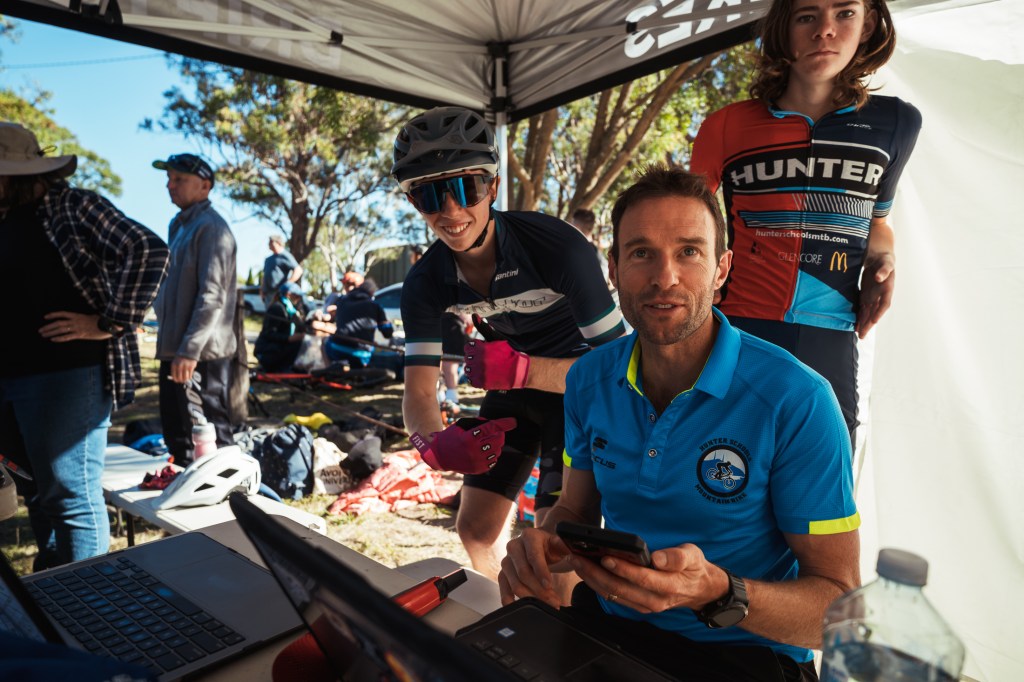
“Outside of mountain biking, we’re building friends,” Jason said. “We’re building resilience skills.”
He explained that the kids and teens he coaches learn to encourage each other even when things get tough. “You see that they have to learn to speak positively and they learn how to talk to their friends when they don’t succeed,” he said.
“Do I pay them out and do I use these negative words? Or do we encourage building up positive language?” he said.
“So that’s a big part of what our coaches are doing. And that part of coaching is to teach people how to deal with failure. That is it okay to fail. And then what happens next.”
He spoke about trying something a few times, then doing something that makes people feel good again, then returning to the original thing again later, perhaps trying it with a different approach.
This section of the interview was one of the last parts of the Glenrock article that got cut in the final-final-final-final edits. While it was one of many favourite stories within the bigger story, it pushed the article in too many directions. This was more of an Intelligent Action direction than a history-of-Glenrock direction.
But those words keep resonating. I keep thinking what a terrific thing it is that time spent learning something new – the struggling, the failing, the working it out, the overcoming, the success – not only teaches us about how to support this process in ourselves but how to support others. What to say. What not to say. When to push. When to pause.
There are a few different definitions of resilience, but the one I like best emphasises that being resilient isn’t just about getting through something hard and coming out the other side. It’s about building the skills that allow you to adapt flexibly as you cope with challenges you haven’t experienced yet. I used this as the foundation for resilience workshops I ran last year and hope to run again. I love how these school-age riders are learning this through biking: how to support each other and how to support themselves, in ways that carry forward.
Take a moment before jumping to the next task in your day and reflect on this for yourself. What skills have translated for you in surprising ways to make you more resilient? How have abilities you’ve built in one area of your life translated to challenges in another? How has something from your sport life supported a tricky moment in your work or home life? And how have the skills you’ve developed through work or study translated in surprising ways to something you love doing outside of that?
These are prompts to get you thinking in ways that will pay forward next time an unexpected challenge pops up. Little building blocks to recognising the resilience you already possess, increasing your trust in what you can take with you into the future, and why time spent doing one thing might be really valuable in supporting another. If you get the urge to send me a message with your thoughts, I always love hearing that stuff! Your story could inspire someone else!
This post was originally created for The Cognitive Advantage Newsletter. If you want to receive more like it in your inbox once a month, you can join here!
If you want to dive deeper and learn more, there are two ways I can help you:
Online coaching / strategy session: Learn more about your unique cognitive processing style out on the trails (and off them!), and how to build on this with personalised strategies for more flow, less overwhelm and more focus and control when it counts.
The Mastering Cues online course: This self-paced course expands your toolkit for mental efficiency and precision out on the trails. Guide your body under pressure, reduce ‘cognitive load’ and upgrade your riding (or coaching!) abilities from the comfort of the couch!
 Intelligent Action
Leave a comment